Showing posts with label Through Their Eyes: Impressions from AJC Alumni. Show all posts

Thursday, December 14, 2017

A Place of Growth

Dara Bramson, AJC Manager of Programs Abroad


It was early 2010 when I visited the Museum of Jewish Heritage for the first time. The sweeping views and beautiful building amazed me, but I was focused on my purpose there: an interview for the AJC Fellows Program. I had just begun studying sociocultural anthropology—that semester I was taking a museum anthropology course—so I was beginning to ask questions about memory and space in new ways. What is the role of museums in the formation of collective memory? How are exhibitions reflections of institutional missions and national narratives? Walking through the core exhibition, I recall my overwhelming eagerness to have the opportunity to be a Fellow; I knew it would offer me the engagement, knowledge, and experience I was seeking.

Becoming a Fellow offered me so much more. In the short-term, it guided my academic path; in the long-term, it changed my life. I had the opportunity to learn from the MJH staff in New York and AJC staff in New York and Poland, who later became my colleagues when I was hired full-time in 2011. Each one of them—particularly Shiri Sandler, Tomek Kuncewicz, and Maciek Zabierowski as well as a number of brilliant mentors—shed light on novel perspectives that contrasted with my previous experiences in Poland and served as invaluable resources professionally and academically.

The past seven years working for the AJC in Poland as Manager of Programs Abroad has been a formative time in my personal and professional life. Facilitating academic experiences for hundreds of students, particularly the Program for Students Abroad, Customized Programs, and the first Human Rights Summer Program, which I was fortunate to co-lead with Yael Friedman, enabled me to learn and grow exponentially as an educator and researcher. Editing the newsletter and academic journal shed light on the gravity of the AJC’s impact through reading hundreds of in-depth reflections. What I have gained through this experience is immeasurable. I am grateful to have been engaged in this meaningful work that allowed me to honor the memory of victims and foster dialogue to learn from the past. I look forward to remaining involved with the important mission of the institutions and keeping in touch with you all.

Thursday, August 10, 2017

Black & White

Natasha Caudill, 2017 HRSP Alum 


“Nothing here is black and white,” our tour guide explained. “The world is very complicated.” He continued gesturing towards the rows of black and white faces lining the walls. This discussion of color or lack thereof continued throughout our tours of the Auschwitz-Birkenau concentration camps. In fact, everything we saw and did during the week of the AJC’s Human Rights Summer Program seemed to involve the debate of experiencing history in color or black and white. Our tour guide had not been wrong; except in the case that quite literally, everything is black and white for me.

I was born with Achromatopsia, a disorder that among its various vision impairments, is often defined by a lack of color vision. I have only ever seen the world in black and white and in shades of gray due to this. This lack of color is also how we must view most of history before the development and use of colorized media. For anyone who can see color, this impairment in viewing historical photographs and video is understandably unnatural. I have learned that many people see the black and white as a barrier that makes it hard to truly feel the impact of what is being seen. So, is the authenticity of viewing and experiencing history defined by seeing it the way it was originally presented to us or in the way that is most comfortable to our own standards? While this question would probably produce more debate than answers, I can at least offer my own literal view.

Seeing a gas chamber that aided the murder of 1.1 million people in black and white did not make it any less horrifying. Looking at a lake containing human ashes in black and white did not make the scene any less painful. Seeing the rows of faces of men and women who perished at Auschwitz I and Birkenau in black and white did not make me any less sad than anyone else. For me, there is no barrier that needs breaking when touring a site like this in person. In black and white or in color, we must first be grateful that we get to see and preserve it at all for the memory of those who suffered there.

Natasha Caudill is currently going into her sophomore year of college at Knox College in Illinois where she is pursuing a major in American studies and a minor in Marketing. She was adopted from Ukraine when she was younger but has grown up in Alabama and Tennessee. Her hobbies include harboring an ever-growing collection and shrine of history books, anything theatre related, film, and watching historical documentaries.

Monday, April 24, 2017

A New Chapter

Yael Friedman, Senior Manager of International Fellowships


Since I took the position of Senior Manager of International Fellowships in December, time has flown by. As an Auschwitz Jewish Center Fellow alumna from 2013, I had been interested in working with the AJC ever since. I was, and continue to be, inspired by their important work to teach about the Jewish history of Oświęcim, examine the impact of the Holocaust on the town and in Poland, and fight contemporary discrimination. Having worked even more closely with the AJC since 2015, leading the American Service Academies Program and then the Fellows program as well the following year, this view has been solidified. It is even more rewarding to be part of the program planning process. It is a privilege to prepare and guide military cadets and midshipmen, college and graduate students, and adults, through meaningful engagement with the historical content as well as the personal and emotional experience of being in Poland.

The granddaughter of a Holocaust survivor and two Jews who left Poland during the interwar years, I have a personal connection to this history. My grandmother has regaled me with stories of life in Włocławek, Poland, both the happy memories and those that are deeply upsetting. It wasn’t until I traveled through Poland with AJC staff, my second trip to Poland, that I was able to see some beauty in Poland and develop a deeper understanding of its complex history. With every group, visiting sites related to Polish history, Jewish history, and the Holocaust, is a new and unique experience, and I’m looking forward to many more!

Over these past few months I have had the opportunity to connect with many of you, by phone and in person, and hope to meet many more. I look forward to working with you. Let me know if I can be of any help to you and stay in touch!

Monday, December 26, 2016

In the Mountains

Shiri Sandler, Former AJC U.S. Director


After ten years with the Auschwitz Jewish Center and the Museum of Jewish Heritage, my last day was December 7. I have loved working with the AJC. I've worked with hundreds of students who have touched my heart and taught me so much about memory, history, and ethics. I've been honored to tell the stories of Holocaust victims and survivors, to curate an exhibition about Oświęcim that is now traveling the world, and to come to know so many of you and be trusted with your family histories.

 I couldn't be prouder of what we've accomplished in ten years: expanded the American Service Academies Program (above, in 2013) and AJC Fellows Program, opened new opportunities like the PSA and police programs, and built Café Bergson in the rehabilitated Kluger House. I've been lucky to be in this position and work with such talented colleagues; anyone would be lucky to love their job in the way I have. Thank you for your support these past ten years.

I've been honored to work with you. Personally, this has been one of the most meaningful experiences of my life. I won't be going far, and I look forward to seeing all of you in the AJC family again soon.

Thursday, September 15, 2016

Stolpersteine

Rosemary Bornstein, 2016 AJC PSA Alum

I have always loved flowers. Maybe it is because I am named after a plant, and every nickname I have ever had has been plant-based. Or maybe I just appreciate this marvelous piece of life. So when I arrived at the first site my AJC PSA group visited when touring Birkenau, my initial thought was of how beautiful the field of yellow globe flowers was in the bright sunshine. Seven decades ago, this field was the site of the very first gas chamber in Birkenau.

To visit Auschwitz & Birkenau as a person of Jewish descent is to come face to face with the distinct possibility that you may not exist. My grandparents, who fled from Germany in 1934 to the United States were lucky; my extended family was not. I harbored a lot of anger about the Holocaust and what it did to my family. I decided to participate in the PSA in 2016 to visit these places because I wanted to better understand and honor the unnamed millions representing my family. I expected a country full of death and discovered one full of life.

I grew up Catholic and visited a synagogue only once in my life. Judaism was a part of my identity in name only. So when we went to Shabbat service as part of the program, I had very little idea what to expect. I struck up a conversation with one of the Israeli women sitting next to me and pestered one of the other PSA students with play-by-play questions about what was happening. Two groups of Israeli high schoolers were on their visit to Poland and had crowded the historic Izaak Synagogue to almost bursting.

Then, the singing started. As a Catholic, I spent a huge amount of time in church singing, but it was nothing like this. It began quite calmly, the students singing with as much fervor as you would expect from a bunch of energetic high school students wanting to impress their friends. But as it continued, the singing crescendoed until the synagogue was filled with sound. The students began dancing, first in their place, and then joining into a winding coil around the synagogue, moving to the sound of their prayers. At one point, a man climbed onto the bimah and yelled at the students in Hebrew, “We need to continue on with the service or you will all be sent home!” as they had been repeating the same refrain over and over for ten minutes. It was an incredible experience; people I did not know were singing prayers of a religion I do not follow in a language I do not speak, and yet I felt a sense of community. I also felt a sense of peace – my people had not only survived, but were thriving.

After the five days I spent falling in love with Poland, I left with more questions than I had started with. The most prominent of these was whether or not I could truly claim this experience as my own. My grandparents survived, we did not know any specific relatives who had been murdered by the Nazis, and I did not even follow the religion my people were persecuted for. I was journaling about this in my hotel in Kazimierz on my last night in Poland, when I received an email from my Aunt Olga:

“Dear Family,” it read, “A genealogist and Jewish family researcher in the San Francisco Area has been researching members of the Bornstein/Philippsborn families. A couple of weeks ago she sent me the German translation of a short talk given in Berlin recently. The talk celebrated the dedication of a stolpersteine (commemorative stumbling block) for Elise Bornstein Beset, daughter of Jacobi and Thelka Bornstein, a brother of Philipp Bornstein [my great grandfather].” In the email, she included a photo of the small memorial, the concrete evidence I had been yearning for to understand the feeling of connection I felt to the Shoah as a Jewish person.

The next day, I left to volunteer at the Calais refugee camp in France, hoping to honor the sacrifice my grandparents made for my sake and to bring the refugee experience full circle by helping those who are in need today. The most incredible part of this experience was seeing the community they have built within the confines of a refugee camp, reminding me of the incredible resilience I saw in the Jewish community in Krakow.

There is a special beauty in life continuing where it was once destroyed. It is the beauty I see when I think about what my family and I have because my grandparents left Germany when they did. It is the beauty I saw in the faces of the refugees at the camp in Calais, the hope of a better life shining from their eyes. It is in the overwhelming sense of community I felt watching the Israeli students joyfully dance around the Izaak Synagogue while singing in the language of a people reborn.

As my distant cousin stated at the dedication of my family’s stolpersteine: “There is a Jewish saying that goes: ‘Only those people are dead whom we no longer remember.’ This stone confirms that Elise existed, that she lived here and that at some point was taken away to a concentration camp and killed. I believe Elise would have been comforted to know that she now has eleven relatives who have come after her, some of whom live in Germany again. She will live on in us, and we will never forget her story – and we will continue to tell it.”

Rosemary Bornstein is a student at Saint Louis University, majoring in Public Health, International Studies, and French. She intends to earn Master’s and Doctorate degrees in Public Health with a focus in Communicable Diseases, after which she hopes to work in West Africa to combat Neglected Tropical Diseases. Rosemary intends to spend her life advocating for the treatment and victims of neglected diseases and is passionate about refugee rights. She has lived in five foreign countries and visited more than two-dozen others, documenting her journey here.

Monday, April 18, 2016

Toul Sleng Genocide Museum

Overlooking the city of Phnom Penh from S21,
the Toul Sleng Genocide Museum
Dara Bramson, Manager of Programs Abroad & 2010 AJC Fellow

January 27 is UN International Holocaust Remembrance Day, held on the anniversary of the liberation of Auschwitz in 1945. Institutions and individuals around the globe commemorate this day annually with ceremonies, special exhibitions, and public programs. In Oświęcim this year, AJC staff visited the Jewish cemetery with high school students from Katowice. Since I was an Auschwitz Jewish Center Fellow in 2010 and became a staff member in 2011, I have made a point to partake in commemorative events each year, which have recently included ceremonies at the Museum of Jewish Heritage and at the Auschwitz-Birkenau Memorial Museum. This year, I was honored to have the opportunity to speak at the Documentation Center of Cambodia in Phnom Penh (DC-Cam) on January 27.

I first visited DC-Cam in 2014 while studying peace and conflict in Thailand as a Rotary Peace Fellow. My conversations with their staff quickly blossomed into reciprocal interest in each other’s work; despite geographical differences, we recognized common elements in our shared histories that we could each learn from. I was invited to speak in a classroom at Tuol Sleng Genocide Museum (S-21), where visitors to the former high school-turned-prison tour the haunting site’s empty rooms, some filled with images, artifacts, and testimony. The site is encircled by bustling city streets; the mugshots of prisoners reminded me of those in Auschwitz. At that site, I couldn’t help but reflect on my experience as an educator in Poland, and how concepts of space and place affect communities recovering from the past.

In honor of the commemoration, I spoke at DC-Cam about our work at the Auschwitz Jewish Center and Museum of Jewish Heritage, and important initiatives and concepts related to memory and reconciliation in Poland. I posed questions that arose for me throughout my visit to historic sites and the city itself. These questions were not unlike those I continue to examine in Poland. The event closed with an engaging discussion focused on personal histories, the importance of learning about genocide in a broad context, and developing empowering ideas that can lead to a sense of cross-cultural solidarity.

Dara Bramson is the Auschwitz Jewish Center's Manager of Programs Abroad. Since 2011, she has organized the Program for Students Abroad and Customized Programs throughout the year. In 2010, she was an AJC Fellow and Lipper Intern at the Museum of Jewish Heritage.

Wednesday, December 9, 2015

New Łódź Jewish Cemetery

Todd Hennessy, 2015 AJC Faculty Fellow

The New Łódź Jewish Cemetery, established in 1892, is the largest Jewish Cemetery in Europe. More than 180,000 graves and 65,000 tombstones, ohels (structures built over graves), and mausoleums occupy the cemetery located on Zmienna Street, south of the Radogoszcz train station.

During the Nazi occupation, the cemetery became part of the eastern section of the enclosed ghetto. Between 1940 and 1944, approximately 43,000 burials took place in a part of the cemetery that became known as the “Pole Gettowe" or Ghetto Field. The cemetery was also the site of many mass executions of Jews, Roma, and non-Jewish Poles.

Upon entering the Beit Tahara (funeral home) within the cemetery, I was instantly met with a sense of warmth; not temperature, but comfort. The angles, colors, symbols, textures of this humble room illustrate its importance in the preparation for a Jewish burial. There was also a silence to the room that conveyed its purity, its strength.

After a few moments I began to realize just how many victims of the Holocaust that were not granted this ritual carried out with dignity and respect. The traditional washing (rechitzah), ritual purification (taharah), and dressing (halbashah) of the deceased, the prayers and readings from Torah, The Law of Onen, and the practice of Shemira, all of which were lost.

We all too often focus on the total number of victims of the Holocaust and the manner in which they were murdered. What is sometimes lost, though, is the focus on the manner in which these victims lived; from birth to burial within a culture of beliefs, customs, and traditions.

Todd Hennessy is an educator with The Colorado Holocaust Educators in Denver, CO. For fifteen years Todd taught middle and high school social studies for two public school districts in Colorado. He currently teaches the Holocaust curriculum for the Temple Sinai Religious School in Denver, and is a United States Holocaust Memorial Museum Regional Education Corps Member and Museum Teacher Fellow. When Todd is not teaching, he is a career firefighter / EMT with the South Metro Rescue Authority in Centennial, CO.

Thursday, August 6, 2015

Bobowa's Jews


Waitman Wade Beorn, 2008 AJC Fellow

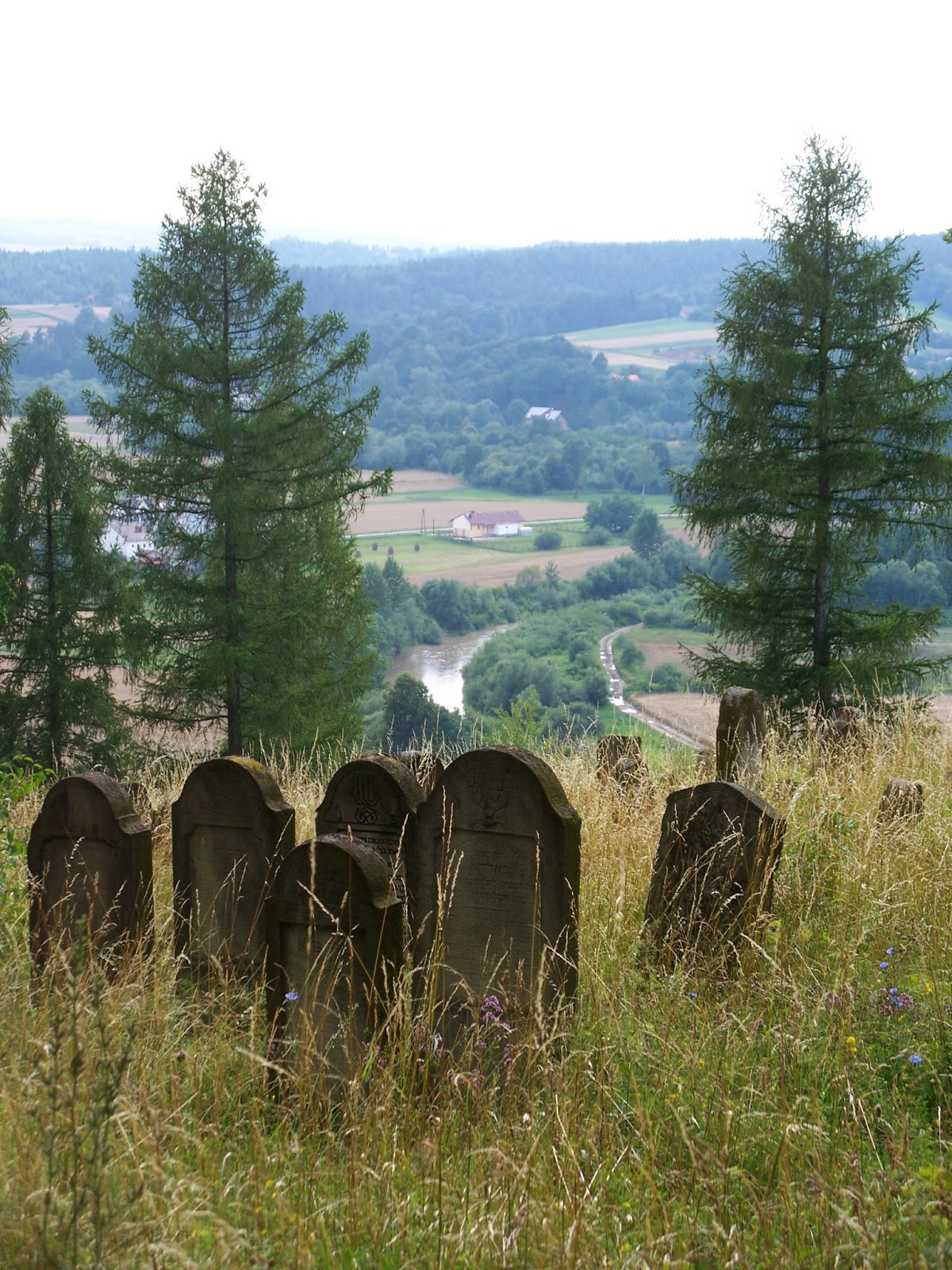
In 1939, the town of Bobowa had a population of approximately 700. During the Holocaust, it served as a concentration point for Jews from smaller villages in the surrounding countryside, including 60 Jews from Oświęcim. During the course of the war, many Jews were sent to work in labor camps in the area. The ghetto was liquidated on August 14, 1942, and the remaining Jewish inhabitants of Bobowa were murdered in a nearby forest. I took this photograph at the Jewish cemetery overlooking the town. There was something unsettling about the combination of the picturesque location, the intact gravestones, and the overgrown condition of the cemetery. Like those of many Jewish sites in Poland, this photograph evokes both the sense of loss of Jewish life and culture due to the Holocaust and physical reminders of the communities that remain.

Dr. Waitman Wade Beorn is the Director of the Virginia Holocaust Museum in Richmond, VA. He received his PhD in History from the University of North Carolina- Chapel Hill in 2011 and is a 2000 graduate of the United States Military Academy at West Point. He is the recipient of numerous fellowships and scholarships, and has published several books. Recently he was honored with the Thomas J. Wilson Memorial Prize for best first book from Harvard Press. He is currently preparing a major project on the Janowska concentration camp outside of Lviv, Ukraine.

Friday, April 3, 2015

The Tatar mosque in Navahrudak

Holly Robertson Huffnagle, 2012 AJC Fellow 

The Tatar mosque in Navahrudak (Polish: Nowogródek), present-day Belarus, was originally built in 1855. In 1993, the building was renovated and re-established as a mosque by imam Ali Szegidewicz. Photo by Holly R. Huffnagle. 

Before the Holocaust, Jews and Muslims lived in close proximity in the kresy (borderlands) of northeastern Poland. While an abundance of literature exists on Jewish-Christian relations in Poland, no scholarly comparison of the history of coexistence specifically between Jews and Muslims in this territory had been done. I chose to pursue this research, documenting (for the first time) the intimate living situation of these two Abrahamic faith minorities in interwar Poland. In a handful of small villages and even larger towns, they traded together on the market square, Muslims bought their meat from the local Jewish shochet (kosher slaughter), the Jews received fresh vegetables from their Muslim neighbors, and they even celebrated certain religious holidays together. These stories complicate previous arguments of self-imposed minority separateness, which argue that social interactions between Jews and non-Jews were uniformly minimal and superficial.

The ideas for this project initially occurred to me during the Auschwitz Jewish Center Fellows Program in 2012. Being a Fellow provided me not only with the necessary background knowledge of Jewish history in Poland, but also with Polish connections who helped facilitate my trip to Warsaw and Białystok to conduct archival research in the summer of 2013. I credit my experience as an AJC Fellow to the successful publication of this project into an article: Peaceful Coexistence?: Jewish and Muslim Neighbors on the Eve of the Holocaust, published by East European Jewish Affairs in January 2015.

Holly Robertson Huffnagle works as an analyst for the U.S. Department of State in the Bureau of Educational and Cultural Affairs. She is also a researcher for the Mandel Center of Advanced Holocaust Studies at the U.S. Holocaust Memorial Museum. She received her Masters from Georgetown University in Global, International, and Comparative history focusing on 20th century Poland and Christian-Jewish-Muslim relations before, during, and after the Holocaust.

Monday, August 18, 2014

Linguistic Memory

Pedro Correa Martín-Arroyo, May 2014 AJC PSA Alum 


During my very meaningful experience as a participant of the AJC Program for Students Abroad, I felt that personal reflection would provide me with more enriching souvenirs than photos. This photograph, however, is a most significant exception. It depicts one of the many memorial tablets, each of them in a different European language, which are present at the Auschwitz-Birkenau monument.
This Judeo-Spanish-written cenotaph particularly attracted my attention because it was, unlike the tablets written in more common languages, empty of flowers or any other offering left by visitors. 
As a Spaniard, I drew an analogy between the bare Judeo-Spanish memorial tablet and the fact that Sephardic language and culture are today virtually extinct, due, in part, to the Holocaust, but also to centuries of persecution in Spain. Laying a little stone on that unadorned tombstone, following the Jewish tradition, was my way of commemorating this immeasurable and irretrievable human loss, as well as paying tribute to those lives not lived.

 Pedro Correa Martín-Arroyo is currently a research intern at the NIOD Institute for War, Genocide and Holocaust studies in Amsterdam (The Netherlands). His previous research involved British propaganda in Spain during World War II and the myth of General Franco as ‘Saviour of the Jews’. Starting in October 2014, he will begin a PhD in International History at the London School of Economic (LSE) under the supervision of Professor Paul Preston, which will focus on Jewish refugees and rescue operations in Spain and Portugal during the Holocaust.

Monday, May 19, 2014

Public Reminders

Molly Greathouse, 2013 AJC PSA Alum


Whenever I reflect on my trip to Kraków and Oświęcim, this is always the image that pops into my head. Although it isn't the typical photo to describe the kind of journey we took through Poland, the message I captured in the image indicated that the history of World War II is still poignant and present for the people of Kraków – impossible to ignore. In America, there are no daily reminders of this time period, but by having simple street art akin to this, the memory of victims and the dangers of discrimination are kept alive though daily reminders.

One of the things I like about street art is that it is able to convey great ideas through a single image or a simple sentence. Public art, such as street art or graffiti, and public initiatives in general have a great effect on those who see them. Because of the fact that these types of expression are open to the public, it is up to the viewer to interpret the message how he or she wishes. This gives great power to the art while also allowing the viewer to participate in creating the message.

Molly Greathouse is a senior at the University of California, Irvine where she is pursuing an International Studies major and French minor. Her professional focus is digital and online media and is pursuing a career for new artists in the music industry. She currently is writing about her travel experiences on her own blog, as well as on The College Tourist.

Saturday, December 21, 2013

Paradox

Sandra Keil, PSA Alumni Fall 2013 


This image illustrates the feeling I had when I saw Auschwitz I for the first time. It is a paradox: the life of the trees and the green meadows are worlds away from the terror that happened behind the barbed wire fence. We visited in October, the peak of striking fall leaves. Before our visit, I could not imagine Auschwitz as anything but grey and drab, but natural beauty unavoidably colored it. A brown rabbit ran and jumped through the destroyed barracks in Birkenau, his freedom and wildness in contrast with the state of the people who were confined there. The picture I took represents the inner struggle I had when I was walking through Auschwitz, and the reflection I took with me when I went back home. 

Sandra Keil is a Master’s student in Middle Eastern Studies at Tel Aviv University. She is currently writing her thesis about Arab Israelis in the Israeli army. She was born in Berlin and is a member of a socialist movement, called the Falcons, which holds seminars, trips and group meetings with kids and teenagers on sexism, racism and anti-Semitism, among other topics.

Wednesday, April 24, 2013

Juxtaposition

Evan Alberhasky, 2012 AJC PSA Alumni

Photo: Museum display at the Auschwitz-Birkenau State Museum & Memorial; Photo and text by Evan Alberhasky.
When I finally sat down and browsed through the 150+ pictures I took during the Program for Students Abroad, I was struck by the composition, albeit unintentional, of this image. The starkness of the shoes speaks for itself – quantity, the immenseness and enormity of the Holocaust in sheer numbers. Yet what caught my attention were the blurred people in front of the shoes, which remain a central, focused background. I was instantly struck by the juxtaposition between the two elements: The shoes represent the Holocaust as a defined, historical event, an epoch that retains its place in history, and one which we can only hope will never occur again. The blurred individuals are indicative of moving time, acting as a gateway between the past, the present, and the future, one in which we as humans are all connected to. The shoes are representative of the permanence of the Shoah while the moving figures are symbols of our ephemeral and temporary existence.

Evan Alberhasky is a Visiting Graduate Student at Hebrew University in Jerusalem studying Jewish Studies and Hebrew. He received a Master’s degree from Kean University in Holocaust and Genocide Studies after receiving his Bachelor’s in History from Indiana.

Wednesday, February 1, 2012

These Shadows

Mike Terry, 2011 AJC PSA participant

Photo: Isaac Synagogue in Krakow, built in 1644; Photo and text by Mike Terry.
The shadows on the walls of the Isaac Synagogue in the former Jewish quarter of Krakow, known as Kazimierz, were a reflection of the entire structure and history. Looking at the Hebrew written on the inner walls of the main room, I wonder how long it took for the crew to restore the words and phrases, sunken characters pulled to the surface. The tender touch and attention of the craft is probably equal to the still complex balance of relations rebuilt, between the powerful and the powerless whose history we visit.

I imagine the conversations in clusters out front and in the foyer, the flow in and out of the doors, week, month, year after year and think that in order to grasp a tragedy, some sort of knowledge of what was actually lost and damaged is required. This structure provides the space for such thoughts. From the outside, the structure seems eternally immoveable, reinforced by the history that took place around it. 

Since attending the PSA program in November 2011, Mike Terry has continued with his degree in Visual Anthropology at the Freie Universitaet Berlin where he is currently concentrating in architectural anthropology. Currently, he is collaborating with Jared Gimbal, also a program alumni, on his semester project involving physical and virtual (online) religious spaces. Mike was recognized this February with an Award of Excellence as a multimedia producer in the Pictures of the Year International competition by the Donald W. Reynolds Journalism Institute.